
Some of the most important conversations of my career lasted less than ten minutes. This is one of them. It made a grown woman cry in my office, and it changed her life in ninety days.
I have been coaching people since 2010, and before that I spent decades in rooms where the truth mattered: four years in the Army, seventeen years inside a bank, and a long career teaching classes that other teachers had walked away from. If all of that taught me one thing, it is this: people rarely fail because they lack information. They fail because they keep telling themselves a story that protects them from the truth.
This post is about that story: how to recognize it, why it is so comfortable, and the three moves that break it.
The Wheel That Was Too Perfect
In coaching we use a simple tool called the Wheel of Life. You draw a circle and divide it into areas: health, career, finances, family, relationships, personal growth, fun, spirituality, environment. Then you score each area from 1 to 10. Within five minutes you have a picture of where your life is strong and where it is wobbling.
Most people hand me a wheel that looks like a flat tire. A 7 here, a 3 there, a 5 somewhere else. That is normal. That is honest. And honesty is where we start working.
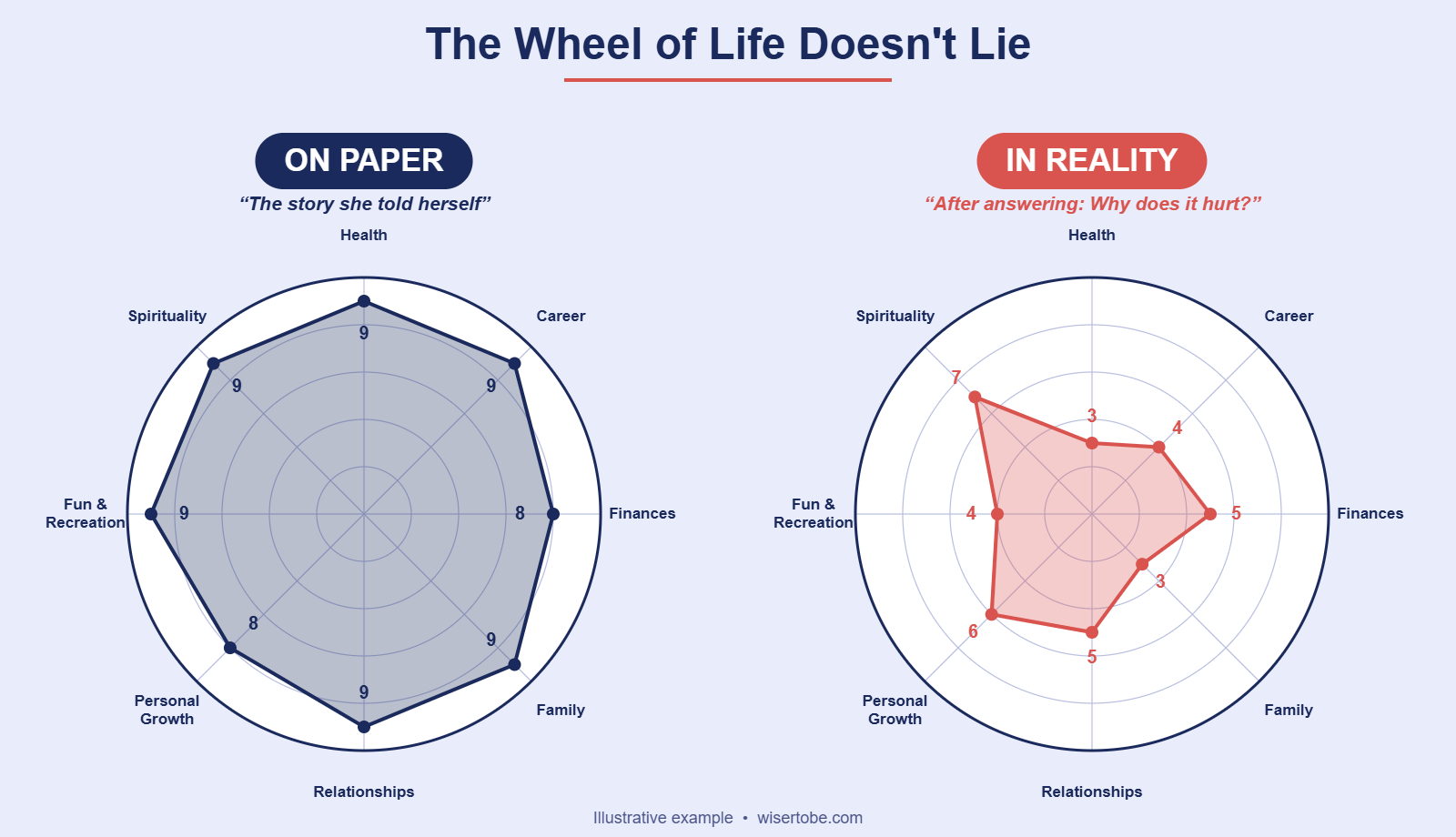
This client handed me something different. Eights and nines everywhere. A nearly perfect circle.
There was one problem. I had listened to her for the whole first session. I had seen how she lived and heard how she talked about her days. And none of it matched that wheel. She talked about being tired. She mentioned, almost in passing, that her son was not living with her. Work was “complicated.” Her health was “fine, I guess.” Everything she said pointed one way, and every number on the paper pointed the other.
She was not trying to fool me. She was doing something far more common and far more dangerous: she was fooling herself.
Why We Lie to Ourselves (And Why It Feels So Good)
Let me be clear. Self-deception is not a character flaw reserved for “bad” people. It is a protection system that every human brain runs.
Psychologists call part of this mechanism cognitive dissonance: the discomfort we feel when what we believe about ourselves clashes with what we actually do. The brain hates that discomfort. And the cheapest way to make it go away is not to change our behavior. It is to change the story.
- “I’m not overweight, I’m just big-boned.”
- “I’m not broke, I’m just between opportunities.”
- “My marriage is fine. Every couple fights.”
- “I’ll start when things calm down.”
Each of those sentences buys a little peace today. And each one charges interest. The longer you tell the story, the more it costs, because you cannot fix a problem you refuse to admit exists. You cannot rebuild a wall you insist is still standing.
I learned this long before I ever heard the word “coaching.” Years ago I was called in to look at a gas station that was going broke with cars at every pump. (I told that story in full in The Gas Station That Was Going Broke.) The owner’s story was “business is slow.” The truth was that money was leaking out the back door every single night. Until he looked at the real numbers, every solution he tried was aimed at the wrong problem.
People work the same way. A perfect Wheel of Life is a business reporting record profits while the account goes negative.
The Most Uncomfortable Thing I Ever Said to a Client
I put her wheel on the table between us, looked at her, and told her the truth as I saw it. I said that in all my years of doing this work, I had never seen anyone tell themselves such a big lie.
I did not say it to hurt her. I said it because every gentle approach would have left her exactly where she was. If I had nodded and said, “Wonderful, let’s talk about goals,” I would have become one more person helping her keep the story alive. And she already had plenty of those.
She cried. A lot. That is the moment where most people, coach or friend, back off. They apologize. They soften it. They rush to make the other person feel better.
I didn’t. I stayed calm, I stayed kind, and I stayed firm. When she was ready, I pointed at each area of her wheel and asked one question: “If this is really a nine, why does it hurt when you talk about it?”
Slowly the numbers started to fall. Health was not a nine. It was closer to a three. Family was not a nine. Her son was living somewhere else, and it was breaking her heart. Career was not a nine. She was stuck in a job that was draining her.
For the first time, the wheel on the table looked like her life. Now we had something to work with.
There is an old proverb that says it better than I can: “Faithful are the wounds of a friend” (Proverbs 27:6). Sometimes the most loving thing you can do for someone is refuse to agree with the lie they are telling themselves.
The Three Tasks
I didn’t give her a twenty-page plan. People who have been avoiding the truth do not need more information. They need movement.
So I gave her three tasks, each one tied to an area of the wheel she had finally admitted was hurting. And I told her something I rarely tell anyone:
“Don’t call me again until you have done all three.”
I’m not going to list her exact tasks here. They were hers, built for her life. What matters is the structure, because that is what you can copy:
- Each task was small enough to start this week. Not “transform your health,” but one concrete action she could take in the next few days.
- Each task was aimed at the real problem, not the comfortable one. No busywork. Nothing that let her feel productive while avoiding what scared her.
- The next conversation depended on finishing them. This removed the escape hatch. She could not come back with excuses and a nice story. She could only come back with results.
That last point is the one most people miss. Accountability is not someone checking on you. It is a structure where you cannot move forward without doing the thing.
What Happened in 90 Days
She called.
Within ninety days of that session, she had lost about 20 kilograms (roughly 44 pounds). She had brought her son back home to live with her. And she had landed a new job.
Three areas of life that had been “nines” on paper and threes in reality became real eights and nines, built on reality instead of denial.
Did I do that? No. She did. All I did was refuse to sign off on the story. The moment she stopped spending her energy defending a fake picture of her life, that energy became available for actually changing it.
That is the hidden cost of self-deception most people never calculate: keeping a lie alive is exhausting. It takes enormous mental effort to keep pretending. When you drop the act, you are not just facing the truth. You are getting your strength back.
How to Catch Yourself in Your Own Story
You may not have a coach sitting across from you right now. So let me give you the same tools I use with clients, in a form you can apply tonight.
1. Score your wheel, then score it again with evidence
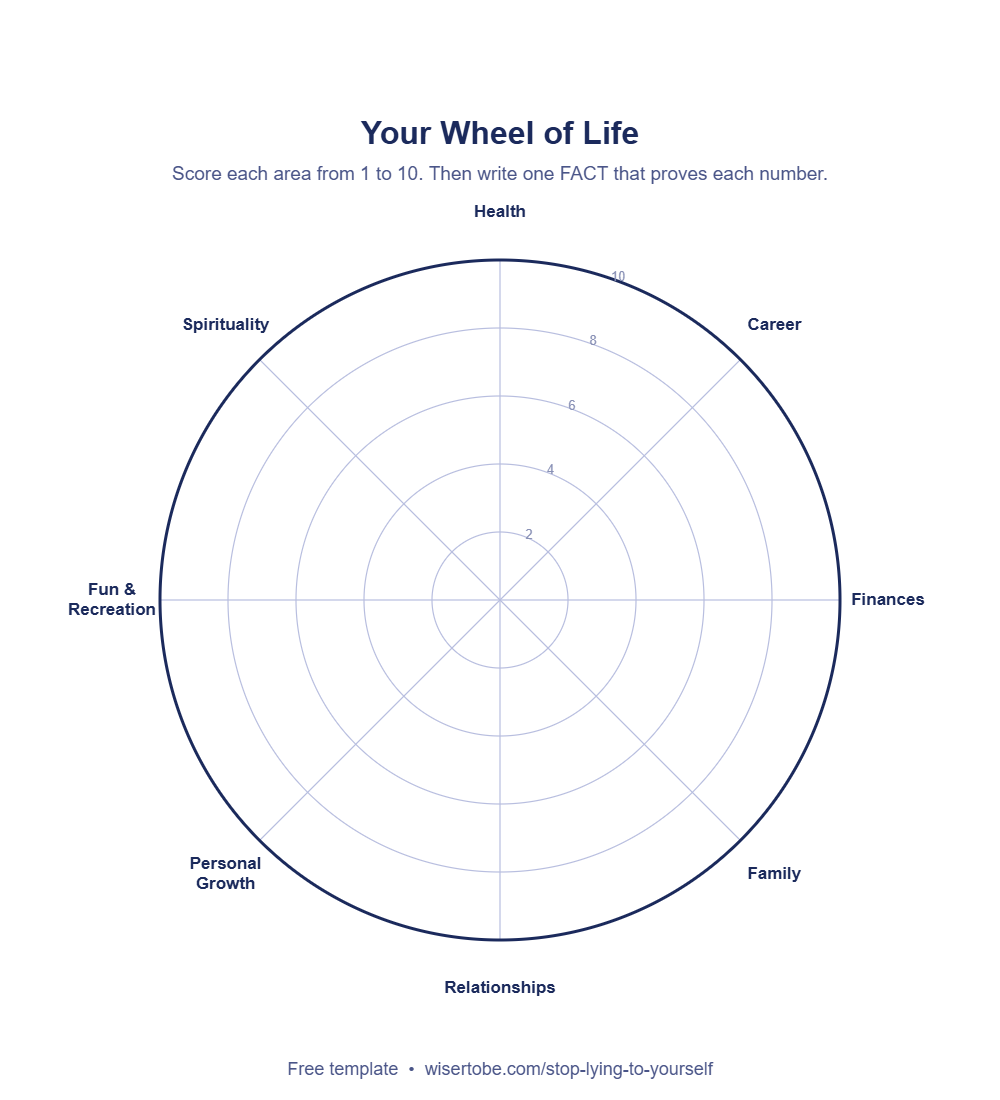
Draw your own Wheel of Life and score each area from 1 to 10. Don’t overthink it. Then go back to each number and write one piece of evidence next to it: a fact, not a feeling. “Health: 8” needs a fact like “I exercised four times this week” or “my last checkup was normal.” If you cannot find a fact that supports the number, the number is probably part of your story.
2. Listen to your own language
Your words betray you before your numbers do. Watch for these phrases:
- “It’s fine, I guess.” Usually means it is not fine.
- “It’s complicated.” Usually means you know exactly what is wrong and don’t want to say it.
- “When things calm down…” Things never calm down on their own.
- “Everybody goes through this.” That may be true, but it is not a plan.
Write down the areas of your life where you use these phrases. That list is your real wheel.
3. Ask the “why does it hurt?” question
For any area you rated high, ask yourself honestly: “If this is really going well, why do I feel tension when I think about it?” Pain is information. Your body often knows the truth before your mind admits it.
4. Find one person who won’t just agree with you
Most of us surround ourselves with people who are kind to our stories. Find one person, a mentor, a coach, a blunt old friend, who cares enough about you to disagree. I wrote more about why that matters in Why Everyone Needs a Coach.
5. Pick three tasks and close the escape hatch
Choose the three areas that hurt the most. Assign one small, concrete action to each, something you can start within seven days. Then build your own “don’t call me until it’s done” rule: no new goals, no new courses, no new plans until those three are finished.
If you need a structure for the weeks after that, my 90-Day Personal Reset walks you through building habits that last. And when motivation fades (it will), this guide on staying consistent will help you keep going.
A Word of Caution About Hard Truths
I want to be responsible here. Directness works when there is trust, respect, and a genuine desire to help. Telling someone a hard truth is not the same as being cruel, and it never replaces professional care when someone is dealing with deep depression, trauma, or a mental health crisis. Part of a coach’s job is knowing where coaching ends and medical or psychological support must begin. If what you are carrying feels too heavy to face alone, please talk to a qualified professional.
For most of us, though, the problem isn’t a crisis. It is a quiet, comfortable story we have been telling ourselves for years. And that story can be broken.
The Truth Is Not Your Enemy
We tend to treat the truth like a threat, something to be managed, softened, or avoided. But the truth is the only solid ground you can build on. Every lie you tell yourself is a floor that will not hold your weight when you need it.
My client didn’t change because I was harsh. She changed because, for the first time in years, she saw her life as it actually was. And once she saw it, she could finally do something about it.
If you feel stuck right now, start there. Not with a new goal. Not with a new app. With an honest look in the mirror. (If you want help figuring out where you are, Feeling Stuck in Life? 7 Ways to Find Clarity is a good next read, and A Practical Guide to Self-Discovery goes deeper into the patterns that keep us where we are.)
Your Next Step (Do It Today)
Before you close this page, take ten minutes and do this:
- Draw your Wheel of Life and score each area from 1 to 10.
- Next to every score, write one fact that proves it.
- Circle every number you could not prove.
- Choose the three circled areas that hurt the most and write one small action for each.
- Make yourself a promise: nothing new until those three are done.
It will be uncomfortable. It might even make you cry, the way it made my client cry. That’s okay. Those tears are often the sound of a story breaking, and of a real life beginning to take its place.
The wheel doesn’t lie. The question is whether you’re ready to stop lying to the wheel.
Mr. Dantas

Mr. Dantas is a coach, mentor and behavioral strategist from Maringá, Brazil, with more than 40 years of experience across the Army, banking, education and coaching. Trained in NLP, he helps adults overcome emotional blocks, build lasting habits and communicate with confidence under pressure.